


Understanding the Federal Courts
Federal District Courts
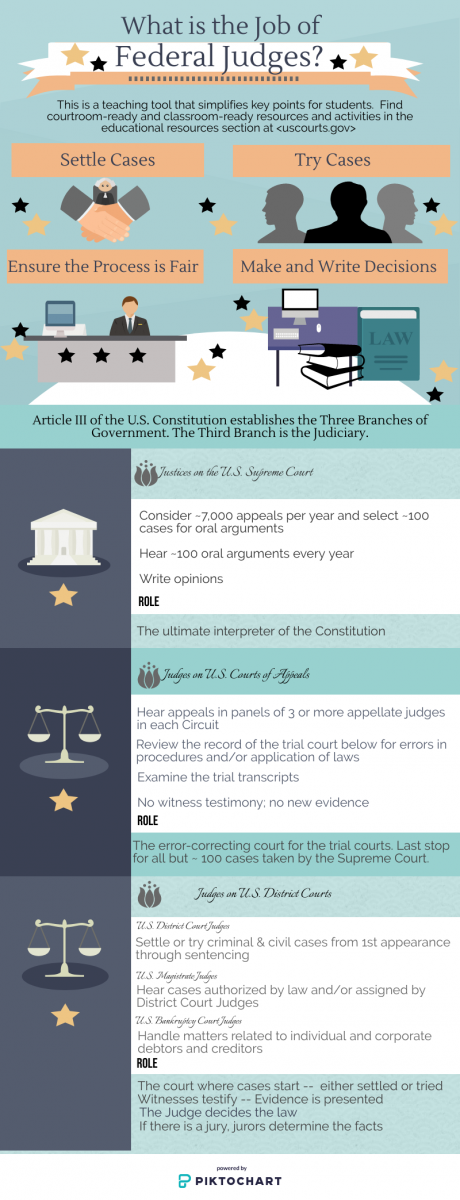
The United States district courts are the trial courts of the federal court system. Within limits set by Congress and the Constitution, the district courts have jurisdiction to hear nearly all categories of federal cases, including both civil and criminal matters. Every day hundreds of people across the nation are selected for jury duty and help decide some of these cases.
There are 94 federal judicial districts, including at least one district in each state, the District of Columbia and Puerto Rico. Three territories of the United States -- the Virgin Islands, Guam, and the Northern Mariana Islands -- have district courts that hear federal cases, including bankruptcy cases.
Federal Courts in American Government
The three branches of the federal government — legislative, executive, and judicial — operate within a constitutional system known as "checks and balances." This means that although each branch is formally separate from the other two, the Constitution often requires cooperation among the branches. Federal laws, for example, are passed by Congress and signed by the President. The judicial branch, in turn, has the authority to decide the constitutionality of federal laws and resolve other disputes over them, but judges depend upon the executive branch to enforce court decisions.
Federal Courts & Congress
The Constitution gives Congress the power to create federal courts other than the Supreme Court and to determine their jurisdiction. It is Congress, not the judiciary, that controls the type of cases that may be addressed in the federal courts.
Congress has three other basic responsibilities that determine how the courts will operate. First, it decides how many judges there should be and where they will work. Second, through the confirmation process, Congress determines which of the President's judicial nominees ultimately become federal judges. Third, Congress approves the federal courts' budget and appropriates money for the judiciary to operate. The judiciary's budget is a very small part — substantially less than one percent — of the entire federal budget.
Federal Courts & the Executive Branch
Under the Constitution, the President appoints federal judges with the "advice and consent" of the Senate. The President usually consults senators or other elected officials concerning candidates for vacancies on the federal courts. The President's power to appoint new federal judges is not the judiciary's only interaction with the executive branch. The Department of Justice, which is responsible for prosecuting federal crimes and for representing the government in civil cases, is the most frequent litigator in the federal court system. Several other executive branch agencies affect the operations of the courts. The United States Marshals Service, for example, provides security for federal courthouses and judges, and the General Services Administration builds and maintains federal courthouses.
Our District's History
Creation and Constitutional Authority
Washington State moved from territorial status to statehood in 1889. Until that time, territorial Supreme Court Justices "rode the circuit" and met only once or twice a year in Olympia to hear appeals from their district court decisions.
The Eastern District of Washington was formed by the March 2, 1905 "Act to Divide Washington into Two Judicial Districts" (Chapter 1305, Session III, 58th Congress). At that time, the state was then divided into two federal districts and a separate judge, Judge Edward Whitson, was appointed to the Eastern District.
iCivics
iCivics is a web site providing games, information and teaching materials designed to increase students' civic knowledge and participation.
Infographics




Additional Educational Resources
The Courts and You: From Suffragist Sashes to Antiwar Armbands(video)
About the Courts:
Court Structure
About Federal Courts
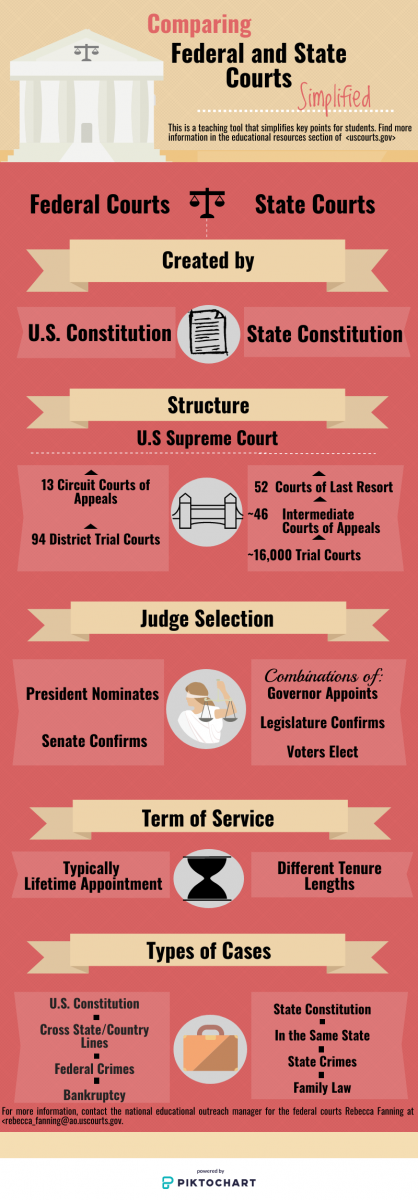
Comparing Federal & State Courts
History of the Federal Judiciary
Court Shorts: Separation of Powers (video)
Jury Related:
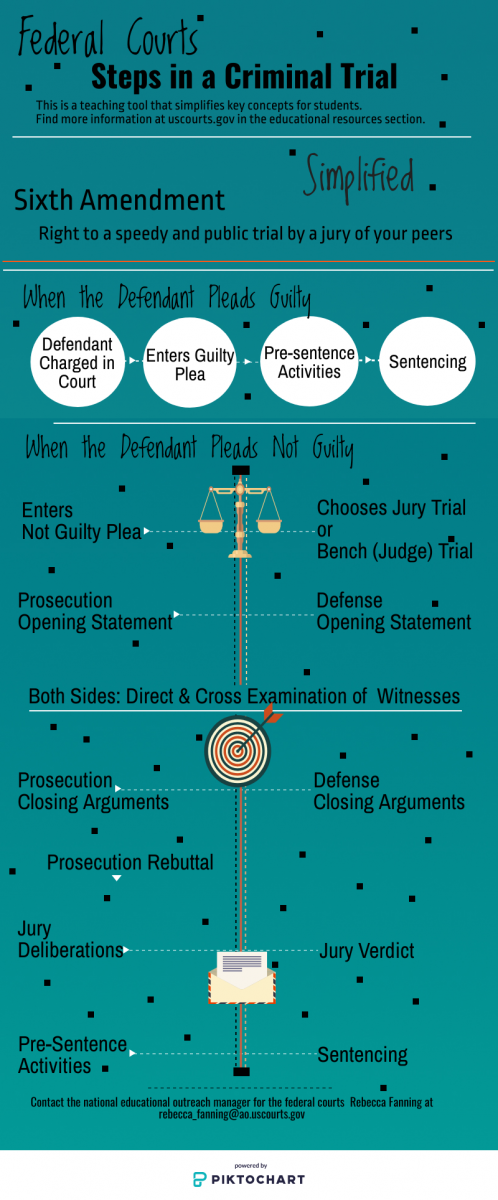
How a Trial Works (video)
Types of Juries (video)
Understanding the Language of a Trial (video)
Teacher Resources:
US Courts Educational Resources
Inside the Federal Courts
Annenberg Classroom
American Bar Association Lesson Plans
Constitution Center